
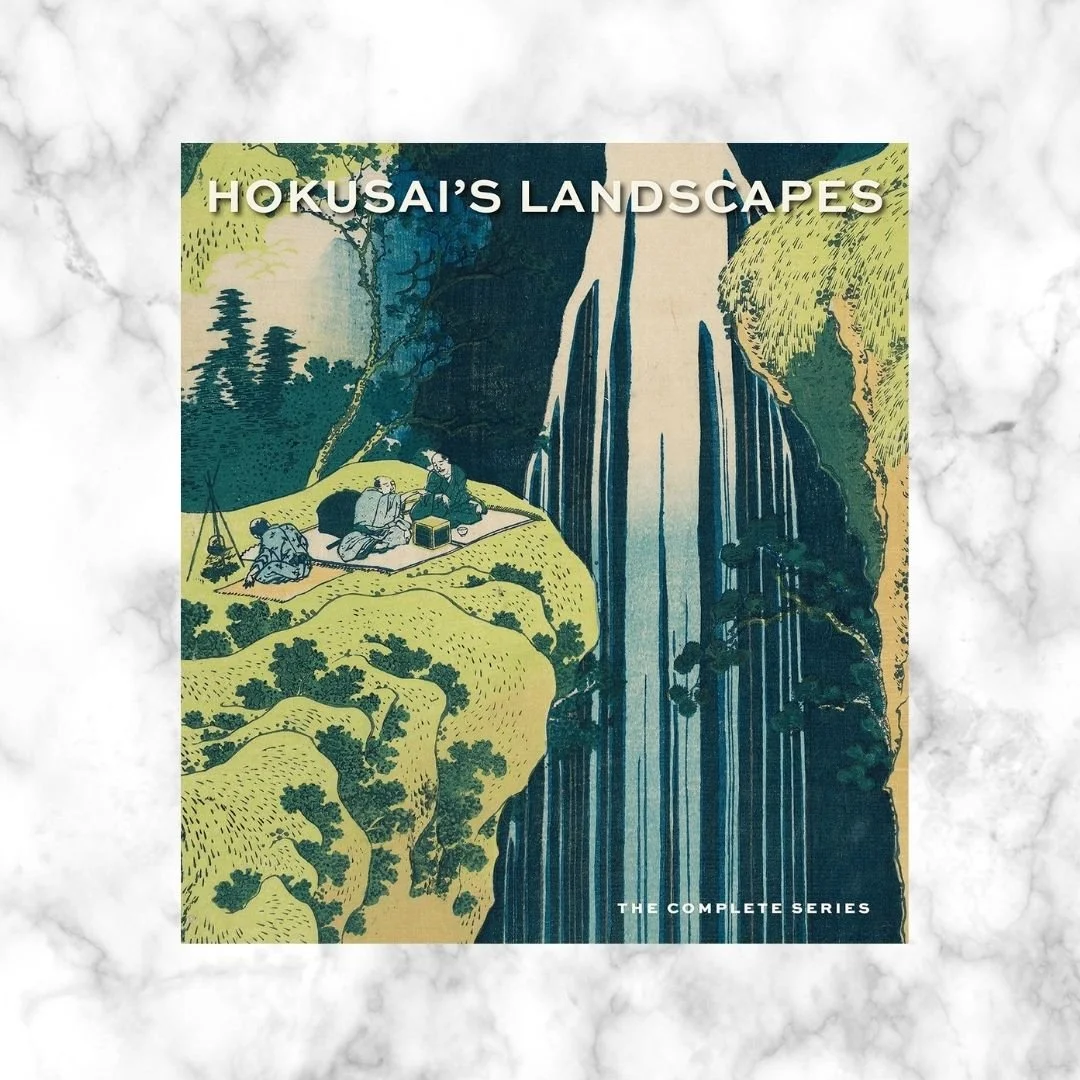
Hokusai's Landscapes (The Museum of Fine Arts Boston)
BY Sarah Elizabeth Thompson
Recommended by: Florine Démosthène, was a 2024 Artist-In-Residence
“Although my work differs visually from Hokusai's, I am deeply inspired by his approach to creating interconnected visual worlds that merge close observation with imagination. Rather than depicting nature as a passive backdrop, Hokusai understood it as a dynamic force that shapes human experience. This is a perspective that resonates with my exploration of ecology, memory, and the interconnected histories of the diaspora.
Like Hokusai's serial investigations of Mount Fuji and the natural world, I approach my practice as an evolving system in which collage, drawing, sculpture, and installation continually inform one another. My work layers fragments of history, mythology, botanical forms, archaeological references, and ancestral knowledge to create speculative environments that exist between archive and invention. Drawing, for both Hokusai and myself, is not simply a means of representation but a method of inquiry that generates new ways of understanding relationships between people, place, culture, and the natural world.”
Book Description: A delightful look at Hokusai's landscape series, drawn from the largest collection of Japanese prints outside Japan
The best known of all Japanese artists, Katsushika Hokusai was active as a painter, book illustrator, and print designer throughout his ninety-year life. Yet his most famous works of all—color woodblock landscape prints issued in series—were produced within a relatively short time, in an amazing burst of creative energy from about 1830 to 1836. These ingenious designs, combining influences from schools of Japanese and Chinese art as well as European sources, display the artist's acute powers of observation and trademark humor, often showing ordinary people from all walks of life going about their business in the foreground of famous scenic vistas.
Hokusai’s landscapes not only revolutionized Japanese printmaking but within a few decades of his death had become icons of world art as well. With stunning color reproductions of works from the largest collection of Japanese prints outside Japan, this book examines the magnetic appeal of Hokusai’s designs and the circumstances of their creation.